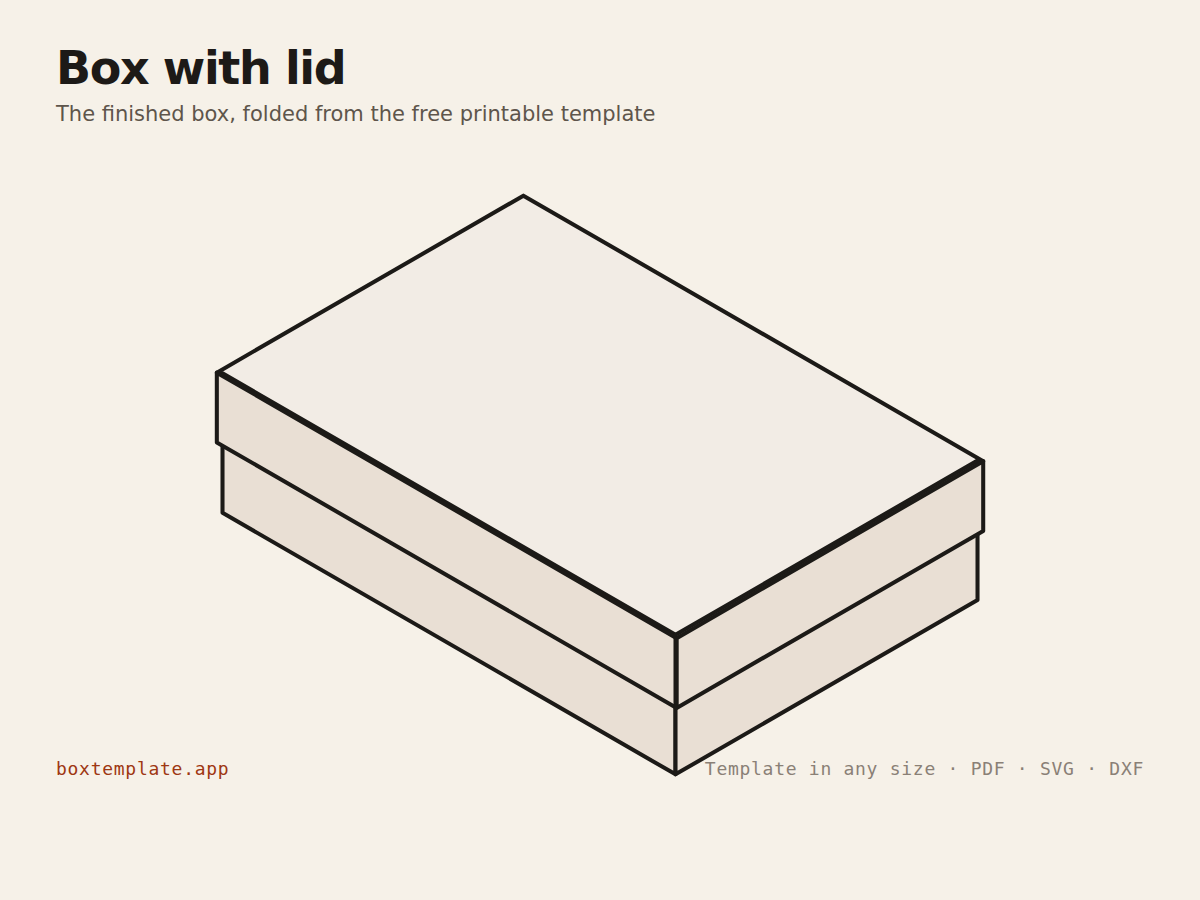
You do not need to buy card to make a good box. A cereal box is a perfectly good sheet of folding card, a shipping carton is free corrugated board, and old greeting cards are thick, stiff and often prettier than anything in a craft shop. The only trick is getting the template onto card that will not go through your printer.
Which card is good for which box
Cereal and food boxes (about 0.4–0.5 mm). Grey on the inside, printed on the outside. Stiff enough for a Box with lid, a Card box, a Match box or a Tray insert. Too stiff for tiny boxes with many small folds.
Shipping cartons (3 mm and up). Corrugated board. Right for a Mailer box, a Shipping carton, a Magazine file or a Box with dividers for a drawer. It needs a craft knife, not scissors.
Greeting cards and postcards (about 0.3 mm). Small but strong, often with a pattern you can use. Good for a Match box, a Gift card holder or a small Pillow pack.
Paper bags and wrapping paper. Too thin for a box on their own, but good for origami: a Masu box folded from a square of strong wrapping paper needs no template lines at all.
Step 1: measure the card's thickness
Box flaps and lids are sized from the card thickness, so this matters more with recycled card than bought card, where the label tells you.
Stack ten layers of the card (cut ten small squares the same size and stack them flat), measure the stack with a ruler, and divide by ten. A 5 mm stack means 0.5 mm card. Type that number into the maker under Advanced settings.
Step 2: check the size fits
Open the cereal box out flat along its glued seam and measure the biggest flat area. The maker's PDF shows the size of each piece; make sure it fits inside that area. If not:
- make the box a little smaller, or
- pick a two-piece shape such as the Box with lid, where base and lid are separate pieces, or
- use the larger side panels of a big cereal box rather than the front.
Step 3: get the template onto the card
Most home printers will not feed cereal-box card or corrugated board. Three ways around it:
Glue the paper print on. Print the template on ordinary paper, stick it to the grey side of the card with a glue stick (spread thinly, right to the edges), and cut and score through both. The paper ends up on the inside of the box, where no one sees it.
Trace it. Lay the paper print on the card and press along every line with an empty ballpoint pen. The dent is your cut and score line. Good for card you want to keep clean on both sides.
Try the printer. Some printers with a straight rear paper path take card up to about 0.4 mm. Check your printer's manual for the heaviest card it accepts. If the card jams or creases, stop; a jammed printer costs more than new card.
Step 4: decide which side shows
The grey side is plain and takes paint, pens and stamps well. The printed side is bright but shows a brand. Choose one:
- Grey outside for a natural, kraft-like look. Stamp it, draw on it or wrap twine round it.
- Printed side inside, so the box is plain outside and opens to a flash of colour.
- Cover the outside with wrapping paper, scrapbook paper or a print-out of your own design. Glue it on before you cut, then cut through both layers so the edges line up.
Step 5: score harder than you think
Recycled card is often stiffer and more brittle than new card, especially corrugated board. Score each fold firmly, then fold away from the score so the dent ends up on the inside of the bend. On corrugated board, fold along the flutes where you can; folding across them crushes the board and needs a deeper score. The scoring guide has more.
Questions
Is cereal-box card strong enough to post something?
Not for heavy items. It is fine for gift boxes handed over in person. For posting, use corrugated board from a shipping carton and the Mailer box, set to the board's thickness.
The grey side is shiny. Will glue stick?
Glue stick and PVA hold on the grey side. The printed side often has a coating that glue slides off, so glue printed side to printed side with double-sided tape instead.
Can I use food packaging for food?
Use the clean, unprinted side against the food, or line the box with greaseproof paper. Do not reuse packaging that held raw meat or anything oily.
Is it safe to put recycled card through a cutting machine?
Thin card such as greeting cards cuts well. Cereal-box card usually cuts with a stronger blade and several passes. Corrugated board is too thick for most home cutting machines; cut it by hand.