The magazine file template, flat and folded
What this template is for
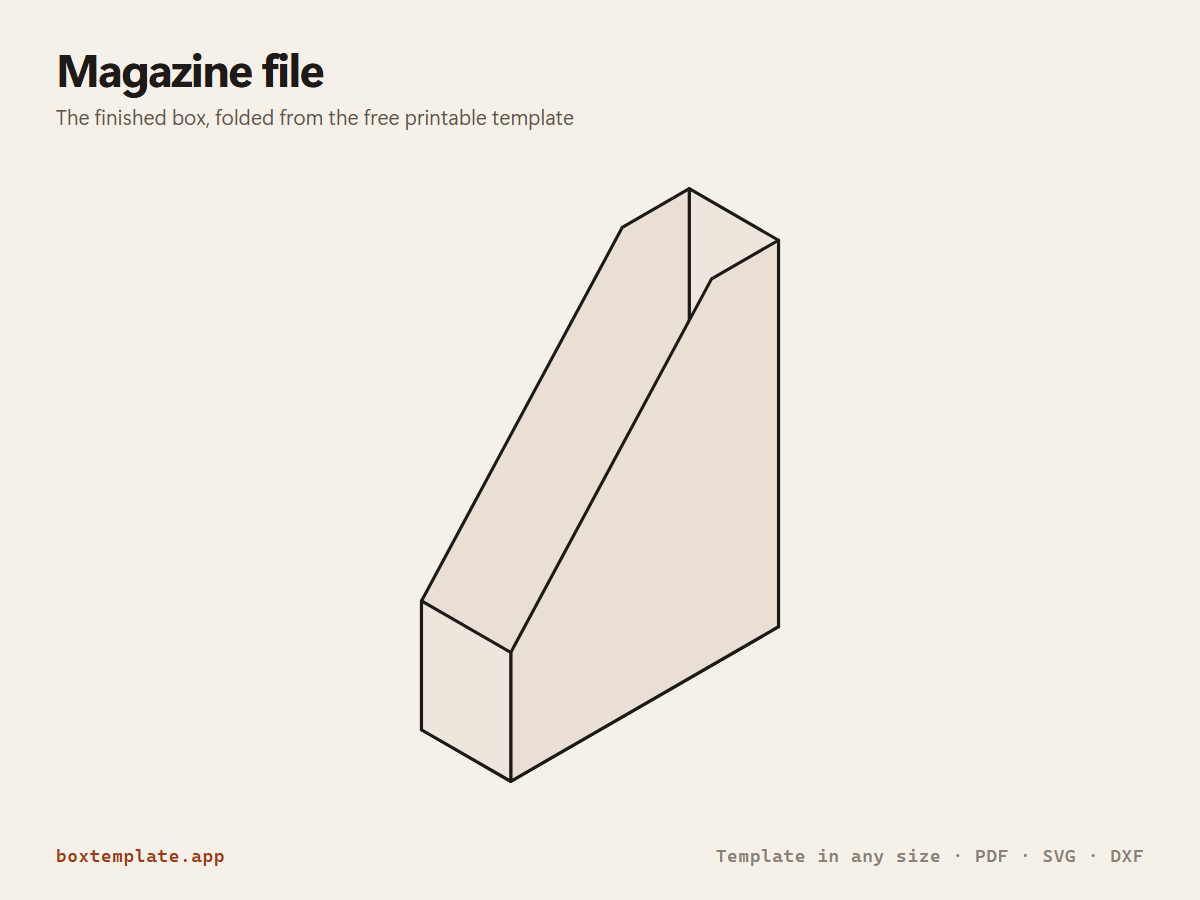
An open box with a tall back, a low front and sloping sides, so what is inside can be read and pulled out. Magazines, catalogues, notebooks, mail, a desk organiser.
Also called magazine holder · desk organiser · file holder · book holder — all the same shape, and this is it.
- Magazines, catalogues and comics
- Notebooks, folders and paperwork
- Mail and bills sorting
- Kids’ books and craft paper
How to use this template
All four downloads are the same magazine file at the same size — only the format changes.
- PDF printing at home
- Print at 100 per cent, or hand it to a print shop as "actual size, no scaling".
- PNG 300 dpi Canva, Photoshop, Procreate
- Upload, lock it in place and design your magazine file on top. Free plan and phone included. Full Canva walkthrough →
- SVG Cricut, Illustrator, Inkscape, Affinity
- Vector, with cuts, folds and labels on separate layers. Cricut and Silhouette walkthrough →
- DXF Silhouette, laser and vinyl cutters
- Two layers, CUT and FOLD — and the one free Silhouette Studio Basic will open.
Printing it
- Type your size above, then download the PDF.
- Print at 100% — never “fit to page”, or every measurement comes out wrong.
- Too big for the paper? Tick Split across several sheets: it tiles across as many as it needs, with overlaps and matching letters to tape together.
How to put it together
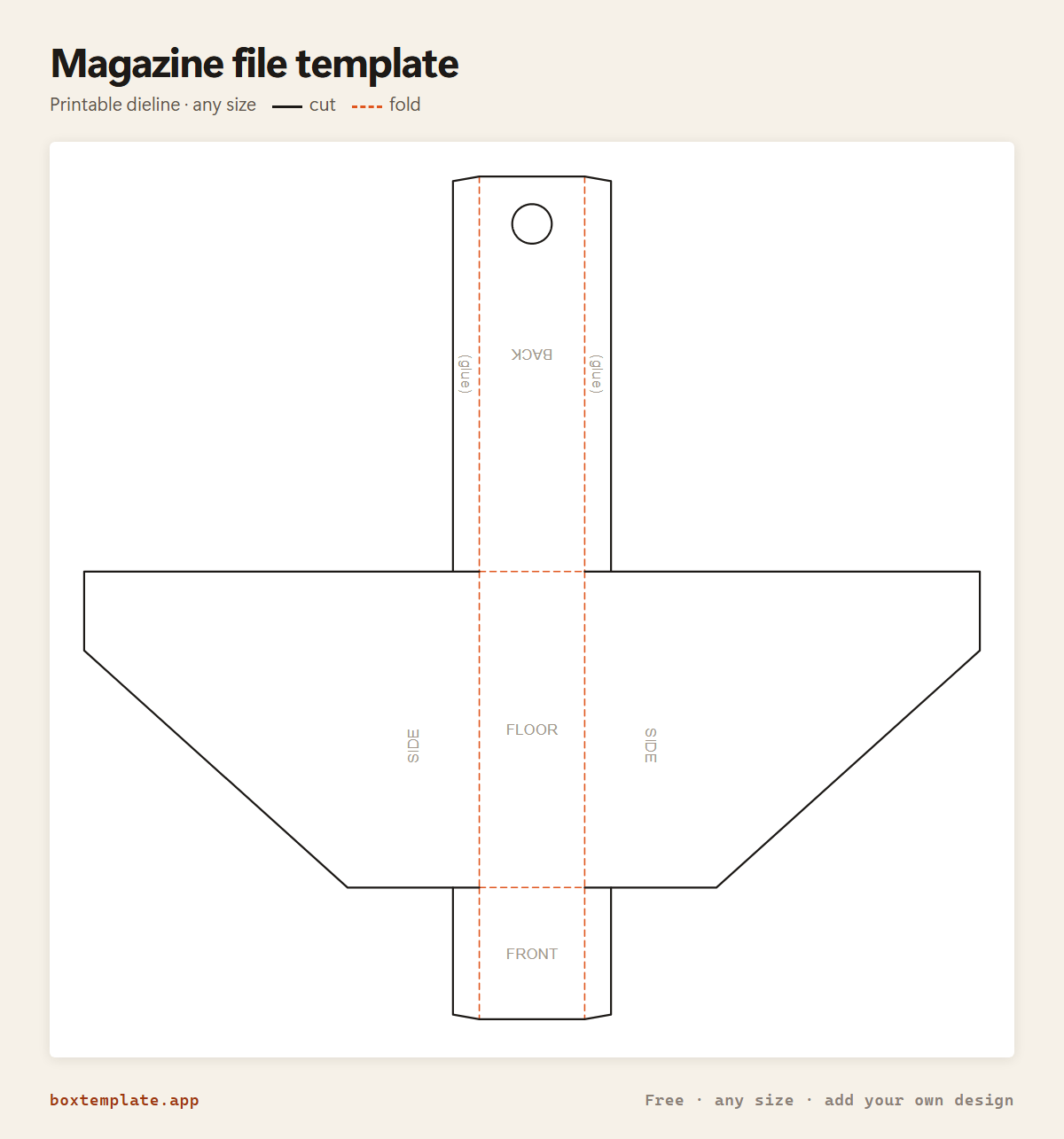
These pictures are the magazine file itself, not a generic diagram — change the measurements above and the template changes, but the three steps never do.
-
Cut the solid lines
Every solid line is a cut. Do the inside shapes first, while the sheet is still whole and easy to hold.
-
Score every dashed line
Dashed lines are folds. Score each one first — an empty ballpoint against a ruler — or the card cracks along the outside of the bend.
-
Fold, glue and hold
Cut the pull hole out first. Fold the four walls up round the floor, then fold each glue tab round the corner and glue it to the inside of the SIDE next to it. At the size it opens with this is a big piece — print it split across sheets and trace it onto thin cardboard, or cut it from a sheet of board directly.
Glue: a glue stick for paper, white PVA on card — hold each seam thirty seconds, and let the box dry standing up.
Questions about the magazine file
- What size should I make it?
- It opens at 80 mm wide, 240 mm deep and 300 mm tall at the back, which takes A4 magazines and folders. The width is the spine — how thick a stack you want to hold. For a desk organiser for pens and notebooks, try 60 wide, 120 deep and 110 tall.
- Will it print on one sheet?
- No, not at the full magazine size: the drawing is about 680 × 640 mm. Switch on split across sheets, tape the pages together and trace the outline onto a sheet of thin cardboard, or send the DXF to a cutting machine. A desk organiser of 60 × 120 × 110 mm fits one sheet of A3.
- What are the sloping sides for?
- So you can read the spines and pull things out. Each side runs level from the back for the distance you set, then slopes straight down to the height of the front. The level part is never shorter than the glue tab, so no tab corner sticks up above the side.
- What board should I use?
- Thin cardboard or 300 gsm card at least — a cereal box works well. Put the printed side of the box inside and it is hidden. It is a tray, so the floor is exactly the inside size you type and the walls fold up outside it.
Print your own design on it
Add a logo, photo or pattern in the panel on the left and drag it onto the magazine file. It is trimmed to the cut outline, embedded properly in the PDF, and never leaves your computer — most free template sites hand you the outline and stop there. How printing your own design works.
Templates like this one
See all 59 templates · For Canva · For Cricut · For Etsy sellers · Getting it printed
Collections: Wedding and party favour box templates · Christmas box templates · Food box templates