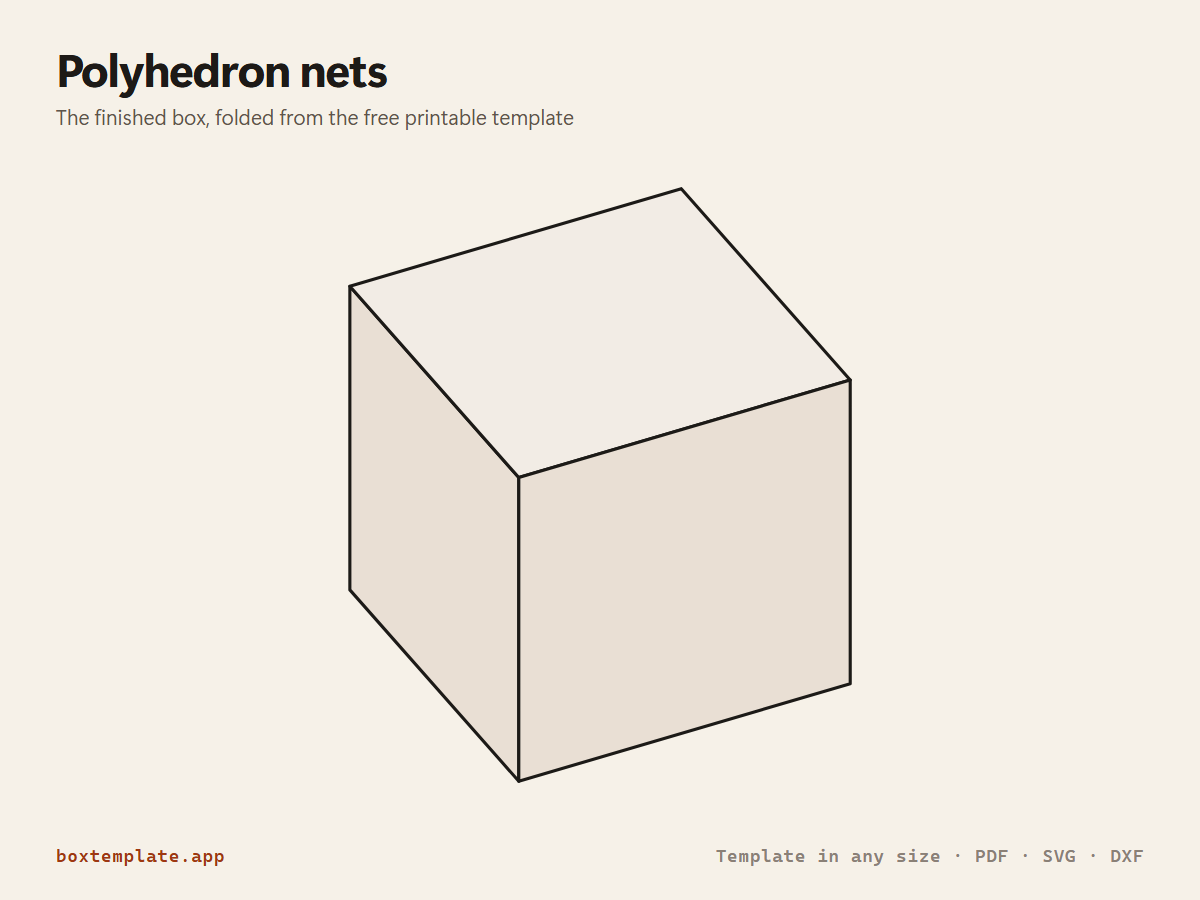
A shape you have folded yourself is easier to understand than one in a textbook. Children see that a cube is six squares, that a pyramid's sides must lean in to meet, and why some flat patterns fold into a solid and others do not. Every template below is free, prints at any size, and works on ordinary printer paper or thin card.
The shapes
Polyhedron nets. Flat nets for solid shapes, ready to cut and fold. Start with the cube, because every face is the same and children can check each fold against the one next to it.
Pyramid. A square-based pyramid. Change the height in the maker and watch the triangles get taller and thinner: a good way to show that the base stays the same while the slant changes.
Triangular prism box and Parallelepiped. Prisms with two matching ends. The parallelepiped is a leaning box, which surprises children who think every box has square corners.
Cone and Mitered cylinder. Curved shapes from a flat sheet. Unrolling a cone shows that its net is part of a circle, not a triangle.
Sphere. A ball made from flat pieces. It is never perfectly round, and asking why is a good discussion: the more pieces, the rounder it gets.
Ideas for a lesson
Count faces, edges and corners. After folding, children count the faces (F), edges (E) and corners (V) of each shape and fill in a table. For a cube: 6 faces, 12 edges, 8 corners. Then ask them to work out V − E + F for every shape. For the solids with flat faces it always comes out as 2. This is Euler's formula, and finding it for themselves is far more memorable than being told.
- Cube: 6 faces, 12 edges, 8 corners. 8 − 12 + 6 = 2.
- Square pyramid: 5 faces, 8 edges, 5 corners. 5 − 8 + 5 = 2.
- Triangular prism: 5 faces, 9 edges, 6 corners. 6 − 9 + 5 = 2.
Will it fold? Draw six squares in different arrangements on squared paper. Children predict which ones fold into a cube, then cut and test. There are 11 arrangements that work.
Surface area you can touch. Before folding, measure each panel of the net and add them up. That total is the surface area of the solid, and the flat net makes it obvious.
Volume by filling. Fold a cube and a pyramid with the same base and height. Fill the pyramid with rice and pour it into the cube. It takes three pyramids to fill the cube.
Puzzles
Soma cube. Seven pieces made of small cubes that fit together into one 3 × 3 × 3 cube. There are 240 different ways to do it, so a class can compete to find new ones. Once they have the cube, challenge them to build other shapes from the same seven pieces. Use card at least 0.3 mm thick, or the pieces squash as they are handled.
Hexaflexagon. A folded strip that becomes a hexagon you can "flex" to show faces that were hidden. Colour each face a different colour before folding, then let children work out how many faces there are and in what order they appear. It became famous through a 1956 magazine column by the puzzle writer Martin Gardner.
Pop-up card. Less maths, more engineering: why does a cut and fold make the card stand up when it opens?
Getting a whole class folding
- Print on paper first, card later. Printer paper (80 gsm) folds easily for small hands. Use thin card for shapes that will be handled a lot.
- Make the shapes big. A cube with 6–8 cm sides is easier to fold and glue than a small one. Type the size you want in the maker.
- Score for them, or teach scoring. Running an empty ballpoint pen along each dashed line with a ruler is safe and makes folding much easier. The scoring guide shows how.
- Glue sticks, not liquid glue. Liquid glue soaks paper and takes too long. A glue stick holds a tab in seconds.
- Scissors only. Keep craft knives with the teacher.
- Print a test page. Measure one square on the printout with a ruler before printing thirty copies. If it is too small, the printer has scaled it; here is how to fix that.
Questions
What age is this suitable for?
Children from about six can fold a cube or pyramid with help. The Euler table suits about nine and up. The Soma cube and hexaflexagon work well with older children and adults too.
Can children colour the nets before folding?
Yes, and it helps. Colouring each face differently shows which faces end up next to each other once folded.
Can I use these templates in school?
The free licence covers personal use, including school projects. Selling printed packs or worksheets made from the templates is not covered. The licence page sets out exactly what is included.