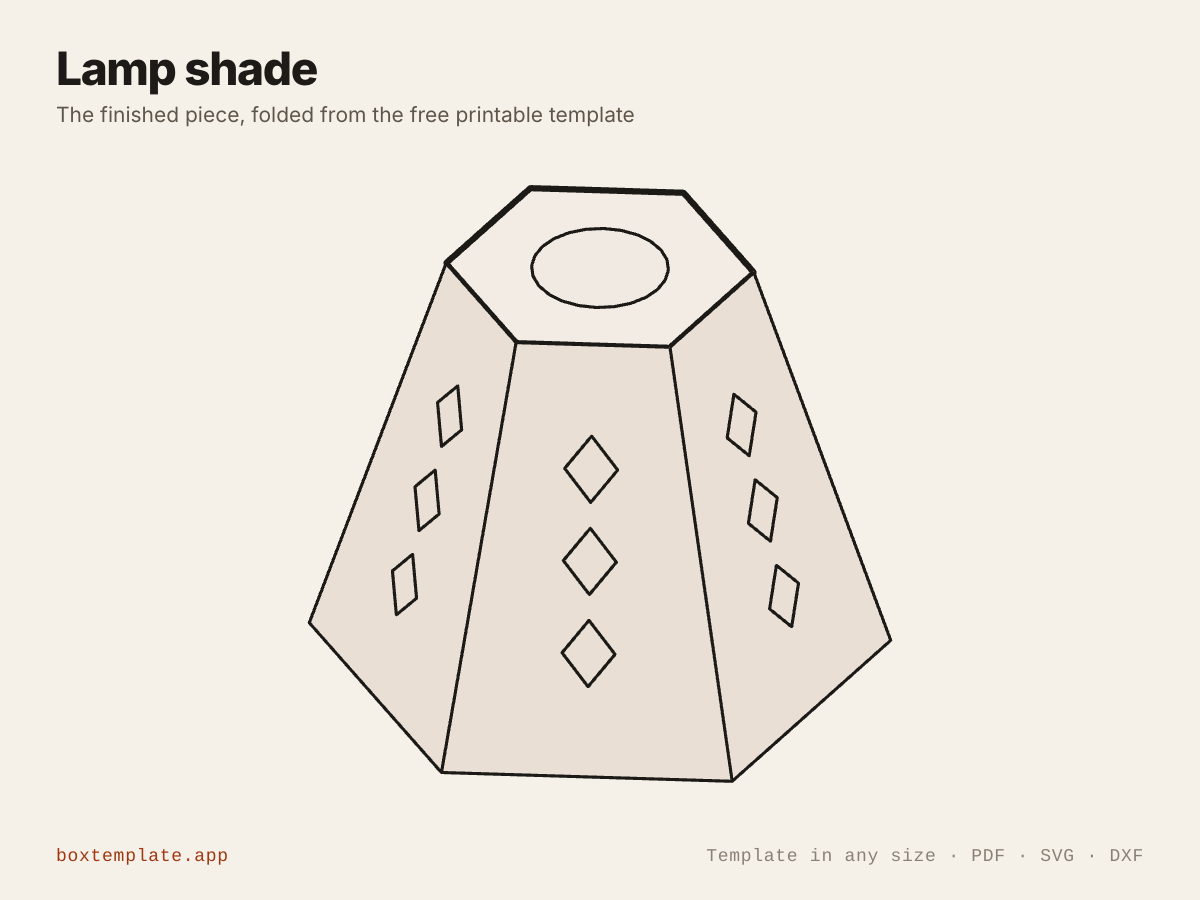
Paper and light go together beautifully. Light shows every fold and facet, and a plain card shape becomes something you notice from across the room. But paper burns, so a paper shade needs a bit more thought than a box. This guide puts safety first, then the making.
Safety first
Use LED bulbs only. LED bulbs run cool. Old incandescent bulbs and halogen bulbs get hot enough to brown and scorch paper, and in time to set it alight. If you are not sure what is in a lamp, change it for an LED bulb before you fit a paper shade.
Never use a candle. Not in a lantern, a tea-light holder or anything made of paper or card. Use a battery tea light or LED fairy lights instead; they give the same glow.
Keep paper away from the bulb. Even an LED bulb is warm. Leave several centimetres between the bulb and the nearest paper on every side, and more above it, because warmth rises. Size the shade in the maker so this gap is built in.
Check it after an hour. The first time you use a new shade, turn it on, leave it for an hour, and touch the paper nearest the bulb. If it is more than slightly warm, make the shade bigger or use a lower-wattage bulb.
Never cover the lamp's own vents, and do not leave a paper shade on when you go out until you have used it for a while and are happy with it.
Use the lamp's own fitting. A paper shade should sit on a lamp's shade ring or harp, or hang from a ceiling fitting, not rest on the bulb.
The shapes
Lamp shade. A classic drum or tapered shade. Type the top and bottom size and the height to fit your lamp base.
Pleated lamp shade. Folds that catch the light in stripes. The pleats also make the shade stiffer than a flat one, so thinner paper works.
Polyhedron lantern. Flat faces at different angles, so each face lights up a slightly different brightness. Good as a pendant shade over a table.
Paper lantern and Star lantern. Hanging or standing lanterns. Light them with LED fairy lights on a battery pack, which can be tucked inside.
Tea-light lantern. A small table lantern for a battery tea light. Lovely in groups along a shelf or windowsill.
Low-poly vase and Sphere. Not made as shades, but with a battery light inside they make a soft glowing ornament.
Which paper lets light through
- Printer paper (80–100 gsm): glows evenly and shows the folds beautifully, but is too floppy for large shades on its own. Good for small lanterns.
- Light card (160–200 gsm) in white or cream: the best all-rounder. Stiff enough to hold its shape, thin enough to glow.
- Heavy card (250 gsm and up): lets little light through. The shade glows only at the edges and through any cut-outs. Good for a moody look.
- Tracing paper or vellum: glows brightly and evenly. Score gently; it cracks if folded hard.
- Kraft card: warm, amber light, but quite dim.
Test before you build: hold a scrap of your paper in front of a lit LED bulb and see how much light comes through.
Making it look good lit
- Fold sharply. Every crease shows when lit, including mistakes. Score every dashed line first; the scoring guide shows how.
- Hide the glue. Glue and tape show as dark marks when light shines through. Use thin glue lines on the tabs only, and put the seam at the back.
- Cut-outs need a backing. If you cut stars or windows out of thick card, glue tracing paper behind them. The light glows instead of showing the bulb.
- Patterns print darker when lit. A design that looks pale on screen can look heavy with light behind it. Print a test panel, hold it to a lamp, and adjust.
Questions
Can I use a paper shade on a ceiling light?
Yes, with an LED bulb and enough space around it, and hung from the ceiling fitting so the bulb does not touch the paper. Polyhedron lanterns and pleated shades both work well as pendants.
How bright a bulb can I use?
Keep to a modest LED bulb, the kind sold as a replacement for an old 40–60 W bulb. Brighter LEDs run warmer. If the paper feels warm after an hour, go down a size.
Can I make the shade fireproof?
Fire-retardant sprays for paper exist, but they do not make paper safe to put near a hot bulb or a flame. Keep to LED bulbs and battery lights, and leave space around the bulb.